What does the WellHeater cost to run?
Honest numbers: at 800W the WellHeater costs about $0.14 an hour at the US average electricity rate — here is the full arithmetic, by rate, by country and against central heating.

The short answer
The WellHeater is an 800W ceramic heater. 800 watts is 0.8 kilowatts, so a full hour at full power uses 0.8 kWh of electricity. Multiply that by what you pay per kWh and you have your cost — there is no other variable and no efficiency trick involved.
At the US average residential rate of about $0.17 per kWh that works out at roughly $0.14 an hour, about $0.55 for a four-hour evening, $1.09 for eight hours a day and around $32.64 over a 30-day month of eight-hour days. In practice most owners pay less than that, because once the room is at the temperature you set, the thermostat cuts the element and the heater stops drawing full power.
Work out your own number
The formula is the same for every electric heater ever made: kilowatts × hours × your price per kWh. For the WellHeater the kilowatts are fixed at 0.8, so you only need two numbers — how long you run it, and what your last bill charged per kilowatt-hour.
Use the calculator below with the rate printed on your own electricity bill. That figure beats any average we could publish, because rates vary by supplier, tariff and time of day.
Work out your own running cost
Enter the price per kilowatt-hour from your electricity bill and how long you plan to run the heater each day. Based on the WellHeater's 800W rating.
- Per hour
- $0.14
- Per day (4 hrs)
- $0.54
- Per 30 days
- $16.32
- Per 4-month winter
- $65.28
Figures assume the heater runs at full 800W for the whole time. Real costs are usually lower because the thermostat switches the element off once the room is at temperature.
Cost at different electricity rates
This table is the arithmetic above, run across the range of rates our customers actually pay. Every figure assumes the heater runs at full 800W for the whole period, so treat them as the ceiling rather than the expectation.
| Rate per kWh | 1 hour | 4-hour evening | 8-hour day | 30 days at 8 hrs/day |
|---|---|---|---|---|
| $0.12 | $0.10 | $0.38 | $0.77 | $23.04 |
| $0.15 | $0.12 | $0.48 | $0.96 | $28.80 |
| $0.17 (US average) | $0.14 | $0.54 | $1.09 | $32.64 |
| $0.20 | $0.16 | $0.64 | $1.28 | $38.40 |
| $0.25 | $0.20 | $0.80 | $1.60 | $48.00 |
| $0.30 | $0.24 | $0.96 | $1.92 | $57.60 |
| $0.40 | $0.32 | $1.28 | $2.56 | $76.80 |
What it costs in your country
We ship to the US, UK, Ireland, Canada, Australia and Europe, and household electricity prices across those markets differ by more than double. The rates below are approximate average household prices converted to US dollars — they move with tariffs and with the exchange rate, so use them to get a sense of scale and your own bill for a precise figure.
| Country | Approximate rate per kWh | 1 hour | 4-hour evening | 30 days at 4 hrs/day |
|---|---|---|---|---|
| Canada | $0.13 | $0.10 | $0.42 | $12.48 |
| United States | $0.17 | $0.14 | $0.54 | $16.32 |
| Australia | $0.25 | $0.20 | $0.80 | $24.00 |
| France | $0.28 | $0.22 | $0.90 | $26.88 |
| United Kingdom | $0.32 | $0.26 | $1.02 | $30.72 |
| Ireland | $0.38 | $0.30 | $1.22 | $36.48 |
| Germany | $0.40 | $0.32 | $1.28 | $38.40 |
Against running your central heating
This is the comparison that actually decides whether the heater saves you anything, so here are the assumptions in full rather than a headline percentage. A gas furnace or boiler heating a whole house typically runs at the equivalent of several kilowatts and warms every room on the circuit, occupied or not. A single 800W heater warms one room, and nothing else.
The table below compares one four-hour winter evening. It is illustrative arithmetic, not a measurement of your home: your boiler size, insulation, gas price and how many rooms you heat will all shift it. What does not shift is the shape — heating one room is cheaper than heating six, and that is the entire mechanism behind any saving.
| Approach | What gets heated | Roughly what it costs |
|---|---|---|
| Central heating at normal setting | Every room on the circuit, including empty ones | Typically several dollars per evening, depending on system and fuel price |
| Central heating turned down 2-3 degrees | Whole house, slightly cooler | Lower, but the house is now uncomfortable to sit in |
| Turned down 2-3 degrees + WellHeater in the room you use | Whole house slightly cooler, occupied room comfortable | The reduced heating bill plus about $0.54 at $0.17/kWh |
| WellHeater alone in one room | One room, up to about 130 sq ft | About $0.54 at $0.17/kWh |
| WellHeater on top of unchanged central heating | Everything, plus one warmer room | Your usual bill plus about $0.54 — this costs you more, not less |
Why your real cost is lower than the table
Every figure above assumes 800W continuously. That is not how the heater behaves once it has done its first job. You set a target temperature, the room reaches it, and the thermostat cuts the element until the temperature drops again. In a small closed room the heater can spend a large share of each hour idle, and an idle element draws almost nothing.
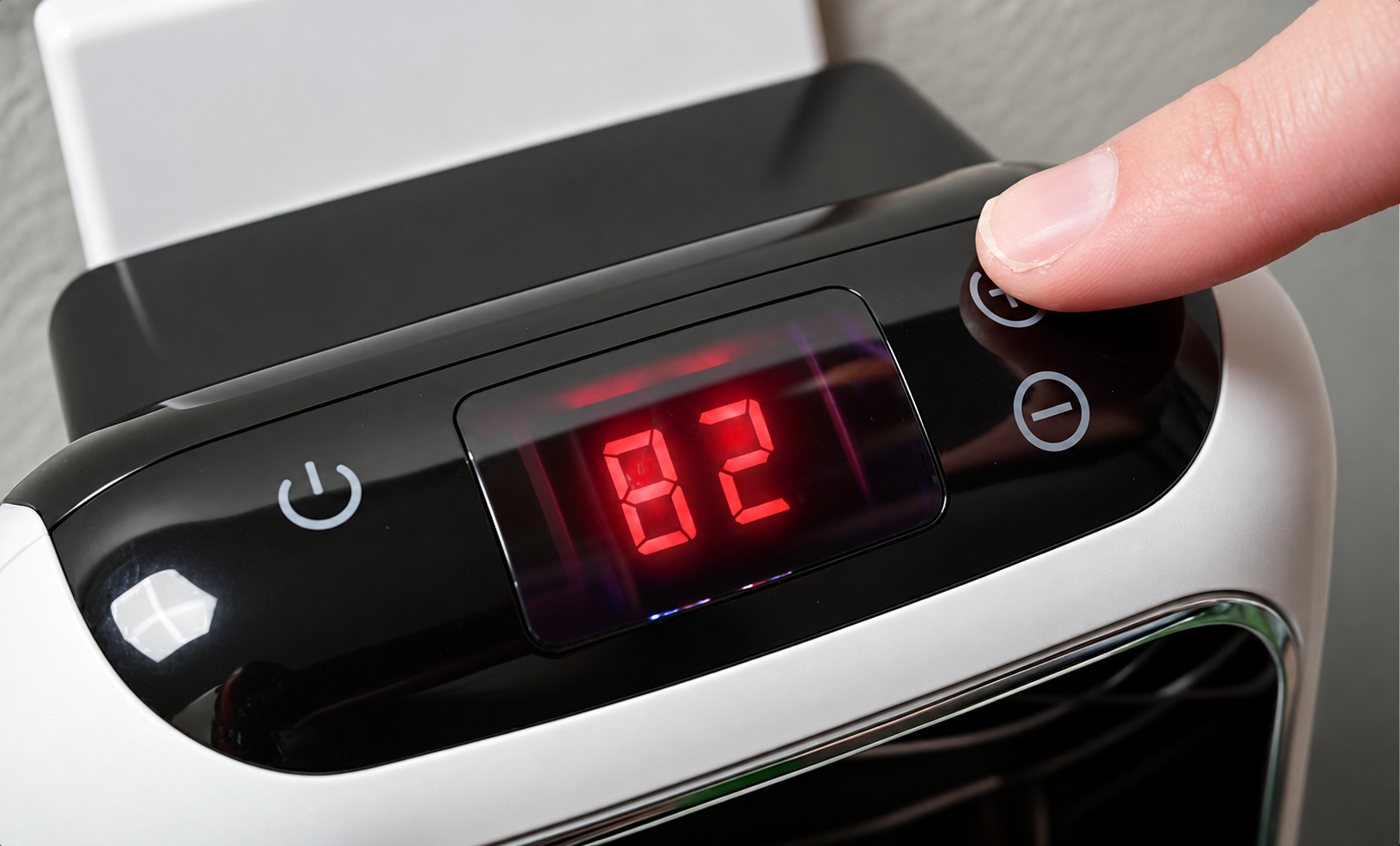
The timer does the same job for the hours you are not thinking about it. Set an hour before bed and the heater stops on its own instead of running until morning. Between the two controls, owners who use them well typically pay well under the full-power figure. How the WellHeater works explains the self-regulating ceramic element behind that behaviour.
Where the saving really comes from
No electric heater is cheap to run per unit of heat — every one of them, from the cheapest fan heater to the most expensive designer panel, converts electricity into warmth at essentially the same rate. Anyone claiming their heater produces more heat per kilowatt than another is selling you physics that does not exist.
The saving is zone heating: turning the main thermostat down a few degrees and warming only the room you occupy. Most households spend their evenings in one or two rooms, so heating four or five is money going out of the window. Our cheapest way to heat a room guide compares that approach against the alternatives, and space heater cost per month runs the monthly maths for any wattage.
Seven habits that cut the cost further
- Drop the central thermostat by 2-3 degrees and let the WellHeater cover the gap in the room you are in.
- Keep the door of the heated room closed — an open door turns one room into three.
- Set the temperature you actually want, not the maximum. The element reaches the same temperature either way; the only difference is how long it runs.
- Use the timer for bedrooms. An hour before bed usually carries a closed room through the night.
- Do not place it behind a sofa or against a curtain where the warm air cannot circulate — see space heater safety.
- Rinse the washable filter every few weeks in heavy use. Restricted airflow means longer run times for the same warmth.
- Move it with you rather than buying one for every room you rarely use — although multi-unit pricing makes a second unit cheap if two rooms are genuinely in use at once.
When it will not save you money
A cost page that only shows savings is a sales page. There are three situations where the WellHeater adds to your bill rather than reducing it, and it is better to know now than after it arrives.
- You leave the central heating exactly as it was. Then you are paying for both, and the heater is pure addition.
- You try to heat a large, open-plan or uninsulated space. At 800W the heater runs constantly, never reaches a comfortable temperature and the running cost stacks up with nothing to show for it. Our garage and workshop heater guide covers why.
- You run it all day in an empty room. Zone heating only saves money when you are in the zone.
How the WellHeater compares with other plug-in heaters on cost
On cost per hour, it does not — and nor does any other brand. At the same wattage every plug-in heater costs the same to run. What varies is how many watts they draw and how quickly they make you comfortable enough to switch them off.
A 1,500W heater costs nearly twice as much per hour as the WellHeater's 800W; it also produces more heat, which matters in a bigger room. In a bedroom, a study or beside a desk, 800W reaching temperature in about a minute usually means fewer watt-hours spent than 1,500W in the same space. How many watts does a space heater use and energy-efficient space heater go through that trade-off in detail.
WellHeater at a glance
| Detail | Specification |
|---|---|
| Heating type | PTC ceramic convection |
| Room coverage | Up to 130 sq ft / 12 m² |
| Time to warm | About 60 seconds |
| Controls | Touch panel + wireless remote |
| Timer | Built-in auto shut-off timer |
| Safety | Tip-over cut-off, cool-touch housing, cool-down mode |
| Filter | Washable antimicrobial dust filter |
| Power | Standard household wall outlet |
| Warranty | 12 months + 30-day money-back guarantee |
Questions we have not answered here? Email support@getwellheater.net — or read our shipping, returns and warranty terms in full.
The verdict on running cost
About $0.14 an hour at the US average rate, a little over $1 for an eight-hour day, and roughly $33 a month if you run it eight hours a day for a month — with the real figure usually lower once the thermostat starts cycling. Outside the US, expect somewhere between $0.10 and $0.32 an hour depending on your national rate.
Whether that saves you money depends entirely on one decision: turning the main heating down. Do that and heat the one room you are sitting in, and the arithmetic works strongly in your favour. Add the heater on top of an unchanged thermostat and it is simply another appliance on the bill. The 30-day money-back guarantee means you can check your own meter for a month and decide from real numbers, and the guide library covers the cheaper-to-run questions in more detail.
Frequently asked questions
Keep reading
Official website offer
Get up to 75% off WellHeater today
Order from getwellheater.net — the only place to get the genuine unit with the antimicrobial filter, tip-over shut-off and a 30-day money-back guarantee.
- Free shipping
- 30-day refunds
- Secure checkout