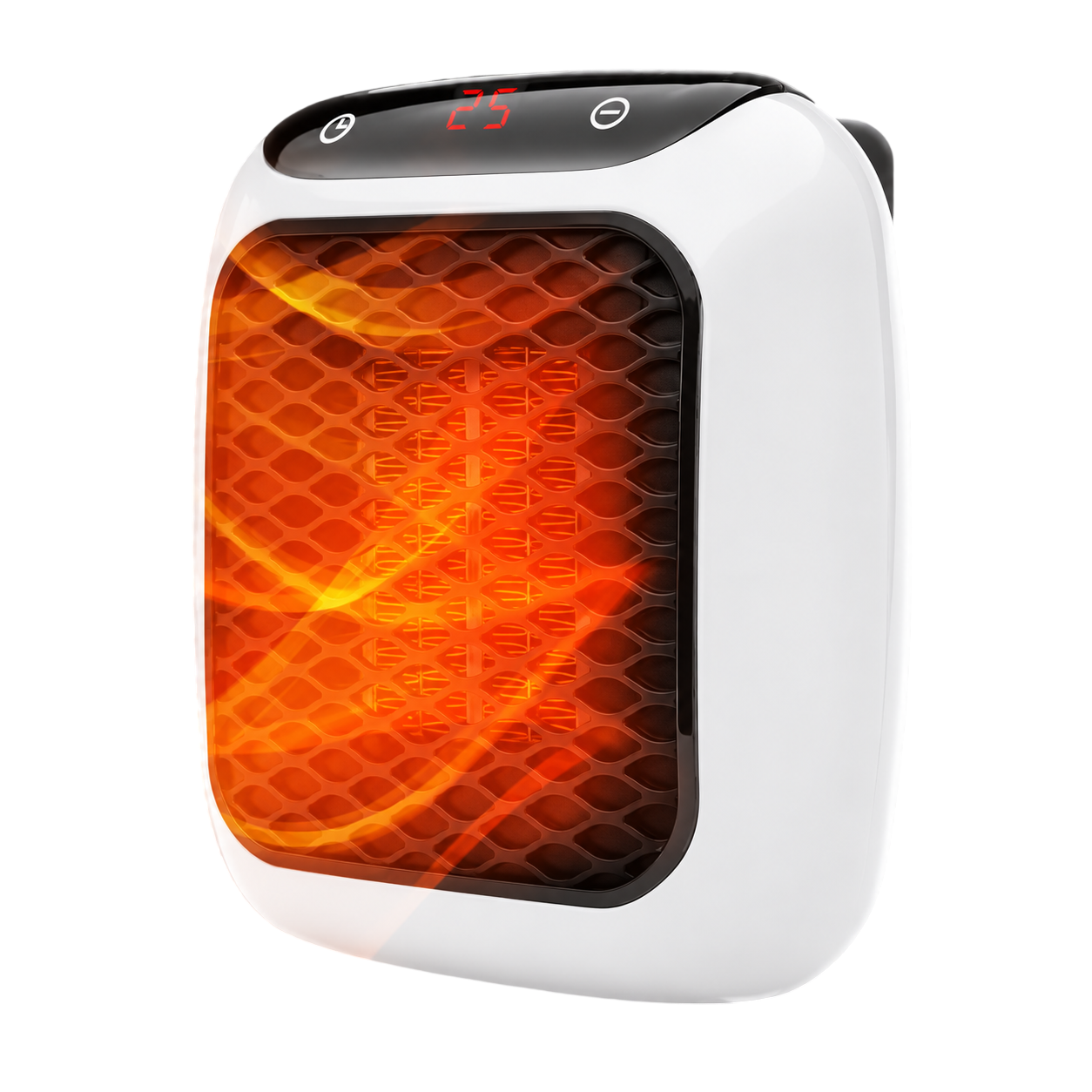
How the WellHeater works
Ceramic heating, in plain English — and why a small plug-in unit can make a room comfortable faster than central heating.
Ceramic PTC heating, in one paragraph
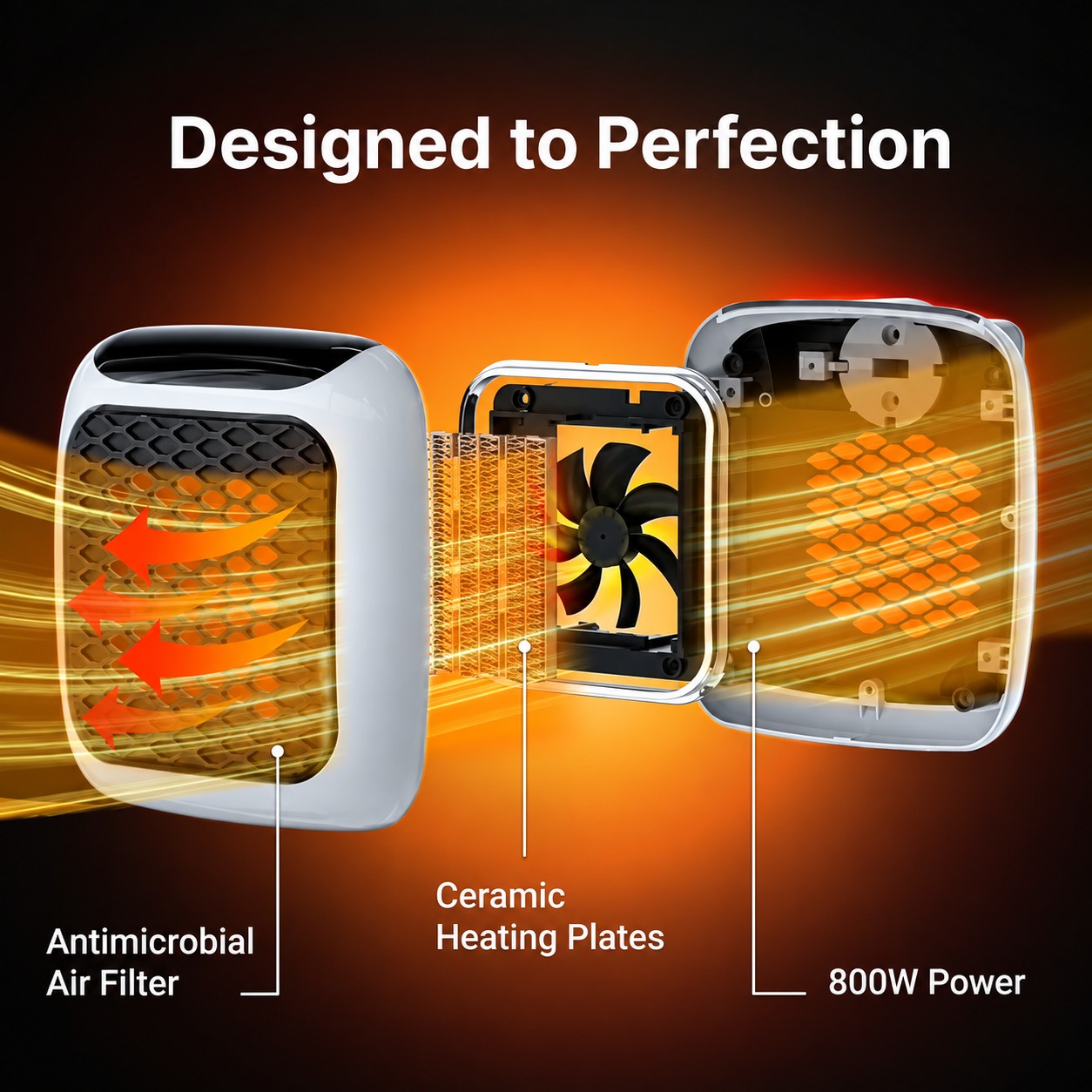
Inside the WellHeater is a ceramic PTC heating element. PTC stands for positive temperature coefficient, which is a technical way of saying the ceramic's electrical resistance rises as it gets hotter. Electricity passes through the ceramic plates, they reach working temperature almost instantly, and a small fan moves air across them and out into the room.
That self-regulating behaviour is the important part. An old bar fire or a coiled metal element keeps drawing the same power whatever happens, and it will glow red if airflow is blocked. PTC ceramic throttles itself: the hotter the plate, the less current it accepts. The element settles at its working temperature instead of climbing past it, which is why ceramic heaters are the type most often chosen for bedrooms, desks and small living rooms.
Why the room feels warm in about 60 seconds
Central heating has a long chain to work through. A boiler or furnace heats water or air, that travels through pipes or ducts, radiators or vents warm up, and only then does the air in the room you are sitting in start to change. Twenty to forty minutes is normal, and you pay to warm every room on the circuit whether you are in them or not.
The WellHeater skips all of it. Plates to air, air to you. The ceramic is at temperature within seconds of switching on, so warm air is leaving the grille in roughly a minute. What takes longer is the room itself — the walls, floor and furniture — which is why a small closed room feels comfortable far sooner than a large open-plan space with a cold floor.
What 800W realistically heats
Honesty matters more than a big claim here. 800W is a zone heater. It is designed to make one occupied space comfortable — a bedroom, a home office, a caravan, a small lounge — not to heat a house. Manufacturers of every brand quote a rough guide of about 10 watts per square foot for a reasonably insulated room, which puts 800W at somewhere around 80 sq ft as a primary heat source and up to roughly 130 sq ft (12 m²) as a warm-up or top-up heater.
The table below is a realistic expectation rather than a promise. Insulation, ceiling height, draughts, single glazing and an outside wall all shift these numbers, sometimes substantially.
| Space | Approximate size | What to expect |
|---|---|---|
| Desk or work corner | Up to 40 sq ft | Noticeable warmth in under a minute; comfortable in 3-5 minutes |
| Small bedroom or nursery | 60-90 sq ft | Comfortable in 10-20 minutes with the door closed |
| Home office or study | 80-120 sq ft | Comfortable in 15-25 minutes; best run 10 minutes before you sit down |
| Caravan, RV or cabin | Up to 130 sq ft | Fast warm-up in an insulated van; slow in an uninsulated shell |
| Open-plan living room | Over 200 sq ft | Top-up warmth only — this is beyond what 800W can hold |
| Cold uninsulated garage | Any size | Not recommended as a primary heater; heat escapes faster than it is made |
The thermostat and timer do the saving
All electric heaters — ceramic, oil-filled, fan, panel — turn essentially 100% of the electricity they draw into heat. No brand can beat physics, and anyone claiming a heater is 90% cheaper to run than another heater of the same wattage is selling you a story. The saving from a plug-in heater is real, but it comes from heating one occupied room for a few hours instead of running a boiler or furnace for the whole house.
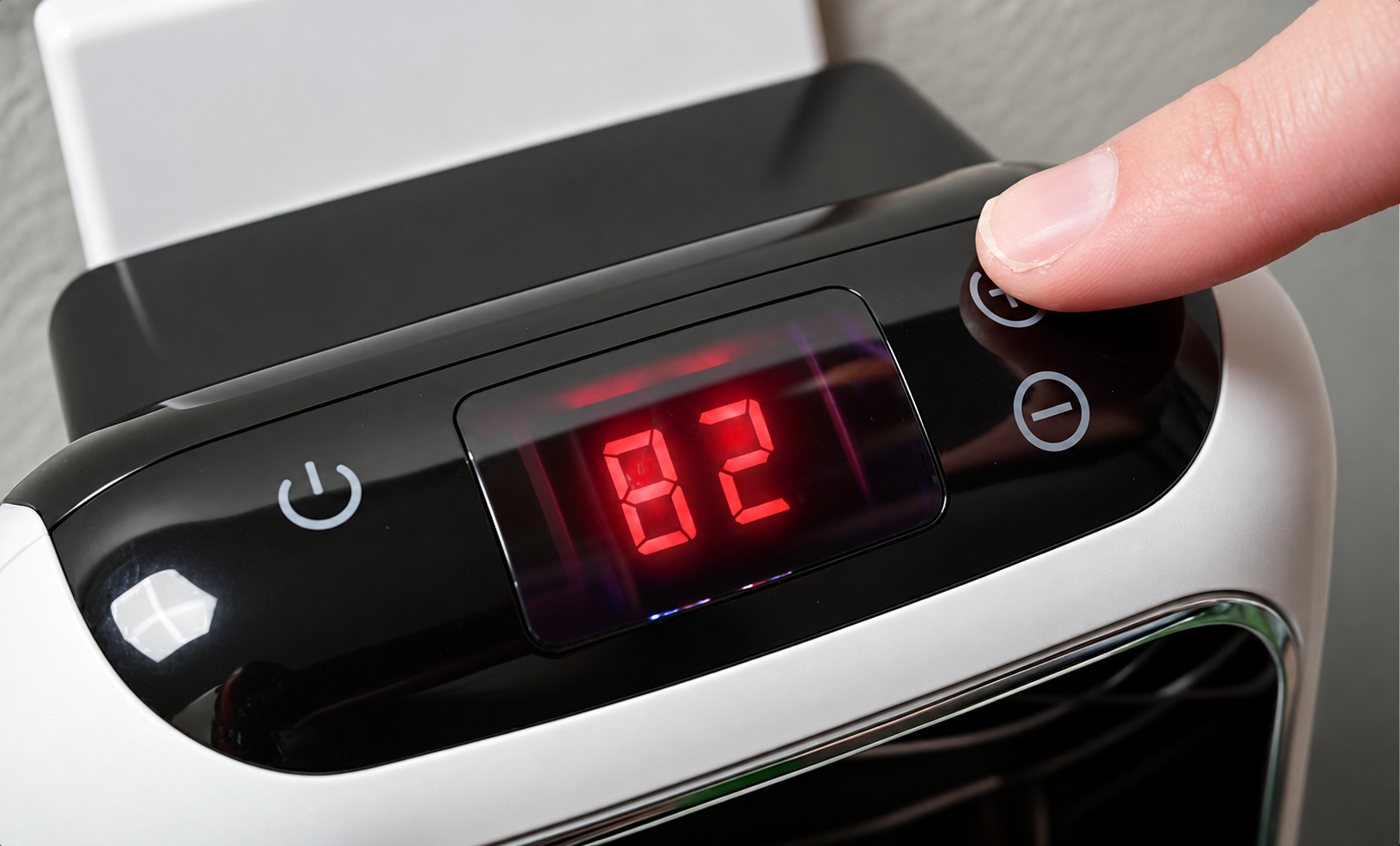
That makes the thermostat and the timer the only two controls that change your bill. The thermostat cycles the element off once the room reaches your target, so a heater set to a comfortable temperature draws full power far less than half the time it is switched on. The timer stops the other expensive habit: leaving it running in an empty room or all night. Our cost-per-month breakdown shows the maths at four different electricity rates, and the cheapest way to heat a room compares it against the alternatives.
| Run time | Energy used | Estimated cost |
|---|---|---|
| 1 hour at full power | 0.8 kWh | About $0.14 |
| 4 hours at full power | 3.2 kWh | About $0.54 |
| 4 hours with the thermostat cycling | Roughly 1.6-2.2 kWh | About $0.27-$0.37 |
| 8 hours a day for a month | About 192 kWh | About $32.64 |
Using it: three steps
There is nothing to install, nothing to mount and no tools involved. The rotating plug means it still sits flush in awkward sockets and behind furniture.
- Plug it in — any standard household wall outlet works. Plug it directly into the wall — never into an extension lead or a multi-way adaptor, because a heater draws far more current than the small appliances those are built for.
- Set your temperature — use the touch panel on the unit, or the included wireless remote from the sofa or the bed. Pick the temperature you actually want the room to be, not the highest number on the display — the element reaches the same temperature either way, the only difference is how long it runs.
- Set the timer — choose a run time and the heater switches itself off. For a bedroom, an hour before bed is usually enough to carry a closed room through the night.
What each control and safety feature actually does
Several of these work in the background with no setting to remember, which is the point — a safety feature you have to enable is a safety feature people forget.
| Feature | What it does | When it acts |
|---|---|---|
| Ceramic PTC element | Converts electricity to heat and self-limits its own temperature | Continuously, every second it is powered |
| Thermostat | Cycles the element off and on to hold your target temperature | Once the room reaches the temperature you set |
| Timer | Shuts the unit down after the run time you choose | At the end of the countdown, unattended |
| Wireless remote | Changes temperature, mode and timer from across the room | Any time — useful from bed or a desk |
| Tip-over cut-off | Cuts power to the element the instant the unit is knocked from upright | Immediately on tipping; resets when stood back up |
| Overheat protection | Shuts the element down if the internal temperature climbs too high | If the grille or intake is blocked or airflow is restricted |
| Cool-touch housing | Keeps the outer casing safe to handle while running | Throughout use; the grille itself still gets hot |
| Cool-down cycle | Runs the fan briefly after shutdown to clear residual heat | Automatically after you switch off |
| Washable antimicrobial filter | Traps dust before it reaches the element and recirculates | Whenever the fan runs; rinse it every few weeks |
The safety side, explained properly
Space heaters have a reputation, and it is worth being straight about where it comes from. The problems reported year after year are almost always about placement and power supply rather than the heater itself: units resting on carpet or bedding, run through extension leads, left unattended for hours, or pushed up against curtains and furniture where the air cannot move.
The WellHeater's protections address the failure modes directly. The tip-over switch kills power the moment the unit leaves upright, so a knock from a pet, a child or a trailing cable ends with a heater that is simply off. Overheat protection covers a blocked intake. The cool-touch housing means an accidental brush against the side is not a burn, though the grille where the hot air leaves is hot by design and should be treated as such. Our full space heater safety checklist covers placement, clearances and overnight use in detail, and there is room-specific advice for the bedroom and the bathroom, where the electrical rules are stricter.
Getting the most heat for the least power
- Close the door of the room you are heating. A closed small room is the single biggest difference between a heater that works and one that seems weak.
- Place it on a hard, flat, level surface with at least three feet of clear space in front of the grille — never on carpet, rugs, bedding or upholstery.
- Plug it straight into a wall outlet, never an extension lead, power strip or travel adaptor.
- Run it before you need the room rather than while you are shivering in it: ten to fifteen minutes ahead is usually enough.
- Use the timer instead of switching off manually — it removes the most expensive mistake, which is running an empty room.
- Set the thermostat to a comfortable temperature rather than the maximum; the room reaches the same point and the element runs less.
- Rinse the dust filter every few weeks. A clogged filter starves the fan, which cuts output and can trip the overheat protection.
- Block the obvious draughts first. A closed curtain and a draught excluder at the door do more for a small room than another 500 watts would.
Common mistakes we see
Two things account for most disappointment with any plug-in heater. The first is asking it to heat too much space — an 800W unit in a large open-plan room or a cold garage will run constantly and still lose. The second is treating it like central heating and leaving it on all day; that is both the expensive way and the way that makes people worry about safety.
A third, smaller one: judging it in the first ten seconds. The air coming out is warm almost immediately, but the room needs time to catch up. If you want a fair test, close the door, run it for fifteen minutes, and then decide. If it is genuinely not right for your space, the 30-day money-back guarantee exists for exactly that.
Cleaning and everyday maintenance
Maintenance is a few minutes a month. Switch it off and unplug it, let it cool, then slide out the washable filter and rinse it under a tap. Let it dry completely before it goes back in — a damp filter in a heater is not something to rush.
Wipe the housing with a dry or barely damp cloth, and keep the intake and outlet grilles free of dust with a soft brush or a vacuum nozzle. Never push anything through the grille into the element, and never use solvents on the casing. Stored over summer, keep it in a dry place rather than a damp garage or shed.
WellHeater at a glance
| Detail | Specification |
|---|---|
| Heating type | PTC ceramic convection |
| Room coverage | Up to 130 sq ft / 12 m² |
| Time to warm | About 60 seconds |
| Controls | Touch panel + wireless remote |
| Timer | Built-in auto shut-off timer |
| Safety | Tip-over cut-off, cool-touch housing, cool-down mode |
| Filter | Washable antimicrobial dust filter |
| Power | Standard household wall outlet |
| Warranty | 12 months + 30-day money-back guarantee |
Questions we have not answered here? Email support@getwellheater.net — or read our shipping, returns and warranty terms in full.
The short version
The WellHeater is a self-regulating ceramic heater that puts warm air into one room in about a minute, with a thermostat and timer that decide what it costs you and automatic protections that cover the ways space heaters actually go wrong. Used as designed — one occupied room, door closed, timer on — it is a genuinely comfortable and predictable way to stay warm without heating the whole house.
Used against physics — a cold open-plan space, an uninsulated garage, or left running all day — it will disappoint, as any 800W heater would. If your space fits, you can see the current official-store pricing or order from the official store with free tracked shipping, dispatch within one business day and a 30-day money-back guarantee. Our guide library goes deeper by heater type, room and cost question.
Frequently asked questions
Keep reading
Official website offer
Get up to 75% off WellHeater today
Order from getwellheater.net — the only place to get the genuine unit with the antimicrobial filter, tip-over shut-off and a 30-day money-back guarantee.
- Free shipping
- 30-day refunds
- Secure checkout