How many watts does a space heater use?
Most space heaters draw between 400 and 1500 watts, with 800-1500W being the common range for a room-sized unit — wattage determines both how fast it heats and how much it costs per hour.

Typical wattage ranges
- Personal and desk heaters: roughly 200-500 watts.
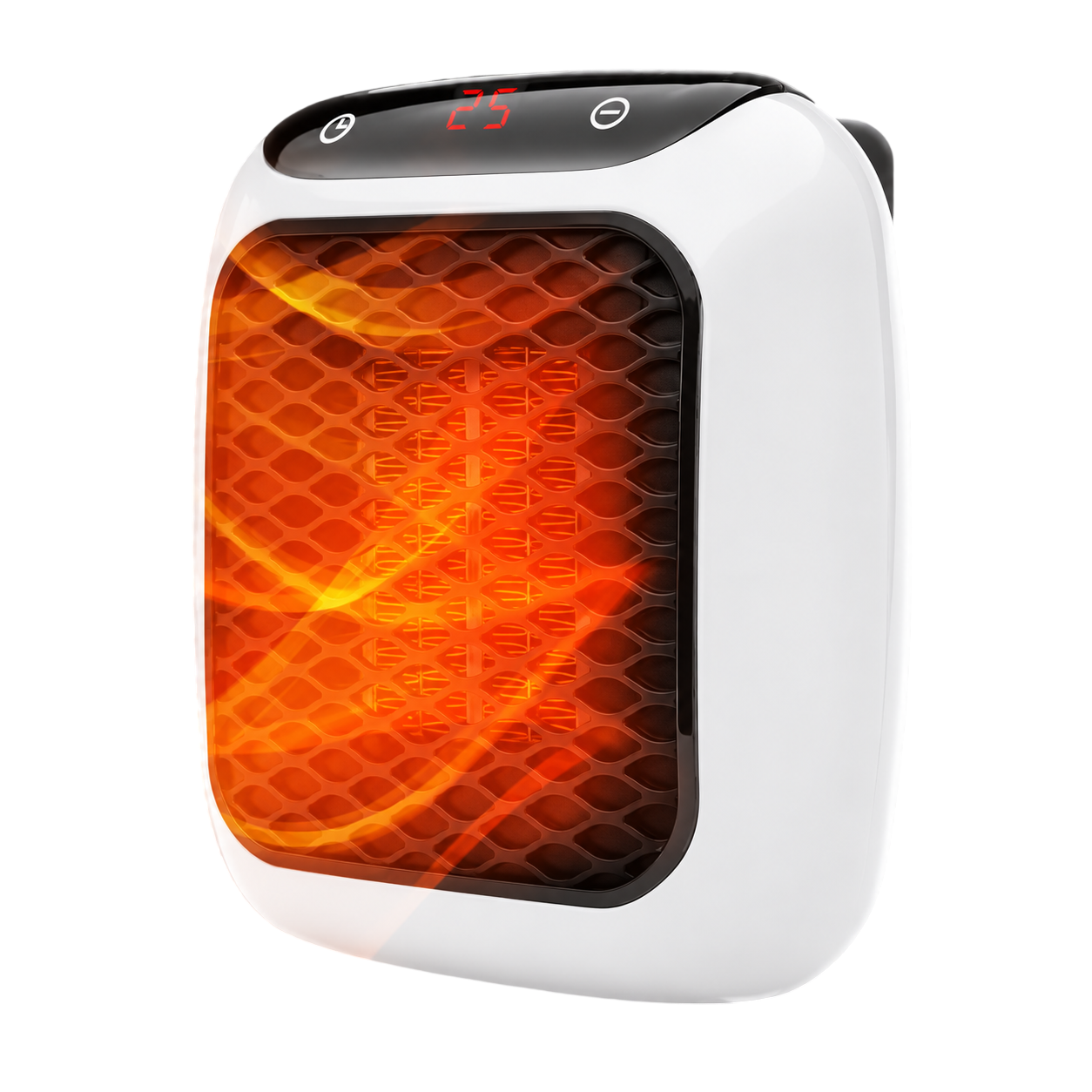
- Compact room heaters: roughly 500-900 watts — WellHeater sits here at 800W, covering up to 130 sq ft.
- Mid-size room heaters: roughly 900-1200 watts.
- Full-size space heaters: commonly up to 1500 watts, often the maximum allowed on a standard household circuit.
How we work watts into money
Divide watts by 1000 to get kilowatts, multiply by the hours you run it, then multiply by your price per kWh. An 800W heater for 3 hours at $0.17/kWh is 0.8 × 3 × 0.17 = about $0.41. Run the same unit for a full 8-hour evening and it's 0.8 × 8 × 0.17 = about $1.09.
This is the exact formula behind every figure in our cost per month breakdown, so you can check any heater's claimed running cost yourself with just its wattage and your electricity rate.
Wattage, room size, and typical cost
| Wattage | Suitable room size | Cost per hour | Cost for 4 hrs/day |
|---|---|---|---|
| 500W | Up to ~65 sq ft (small office, bathroom) | $0.09 | $0.34 |
| 800W | Up to ~130 sq ft (bedroom, home office) | $0.14 | $0.54 |
| 1000W | Up to ~150 sq ft | $0.17 | $0.68 |
| 1500W | Up to ~200+ sq ft, larger or draftier rooms | $0.26 | $1.02 |
What else in your home draws this much power
| Appliance | Typical wattage | How it compares |
|---|---|---|
| Hair dryer | 800-1800W | Similar to or above a room heater, run for minutes not hours |
| Microwave oven | 600-1200W | Similar range, but runs for minutes per use |
| Refrigerator (running) | 100-400W (cycles on/off) | Lower peak draw, but runs continuously all day |
| Toaster | 800-1500W | Comparable wattage to a heater, used briefly |
| Window AC unit (small) | 500-1200W | Similar range, seasonal counterpart to a heater |
| LED light bulb | 8-12W | Roughly 1/100th of an 800W heater's draw |
Will it trip the circuit?
On a 120V supply, a 1500W heater draws about 12.5 amps — most of the capacity of a standard 15A household circuit, and close to the limit if anything else is running on it. An 800W heater draws about 6.7 amps at 120V, leaving considerably more headroom.
On a 230V supply the same 1500W heater draws around 6.5 amps, well within a standard circuit. Regardless of voltage, never share a circuit with another high-draw appliance, and never run a heater through an extension lead — see our safety guide for the full socket rule.
More watts is not always better
A big heater in a small room reaches temperature quickly and then cycles on and off, which doesn't feel meaningfully warmer and can cost more in practice than a well-matched smaller unit running steadily. Match the heater to the room — roughly 10 watts per square foot for an insulated space is a reasonable starting point.
Undersizing has the opposite problem: a heater working continuously at full power in too large a room never quite reaches a comfortable temperature, which wastes the same energy without the payoff. WellHeater's 800W output covering up to 130 sq ft is calibrated for a single bedroom or office rather than an open living area.
Does a lower setting actually lower watts drawn?
Yes — most multi-setting heaters have distinct low, medium, and high power levels that draw genuinely less wattage, not just a fan-speed change. A thermostat-controlled unit adds a second layer of savings by cycling the element off once the set temperature is reached, rather than running the full wattage continuously.
Reading a heater's wattage label correctly
The wattage printed on a heater's label or in its manual is its maximum draw at full power, used for both amp-rating and cost calculations. If a heater has multiple settings, only the highest setting draws that full figure — lower settings will cost proportionally less per hour, so check the label rather than assuming the headline number applies at all times.
WellHeater at a glance
| Detail | Specification |
|---|---|
| Heating type | PTC ceramic convection |
| Room coverage | Up to 130 sq ft / 12 m² |
| Time to warm | About 60 seconds |
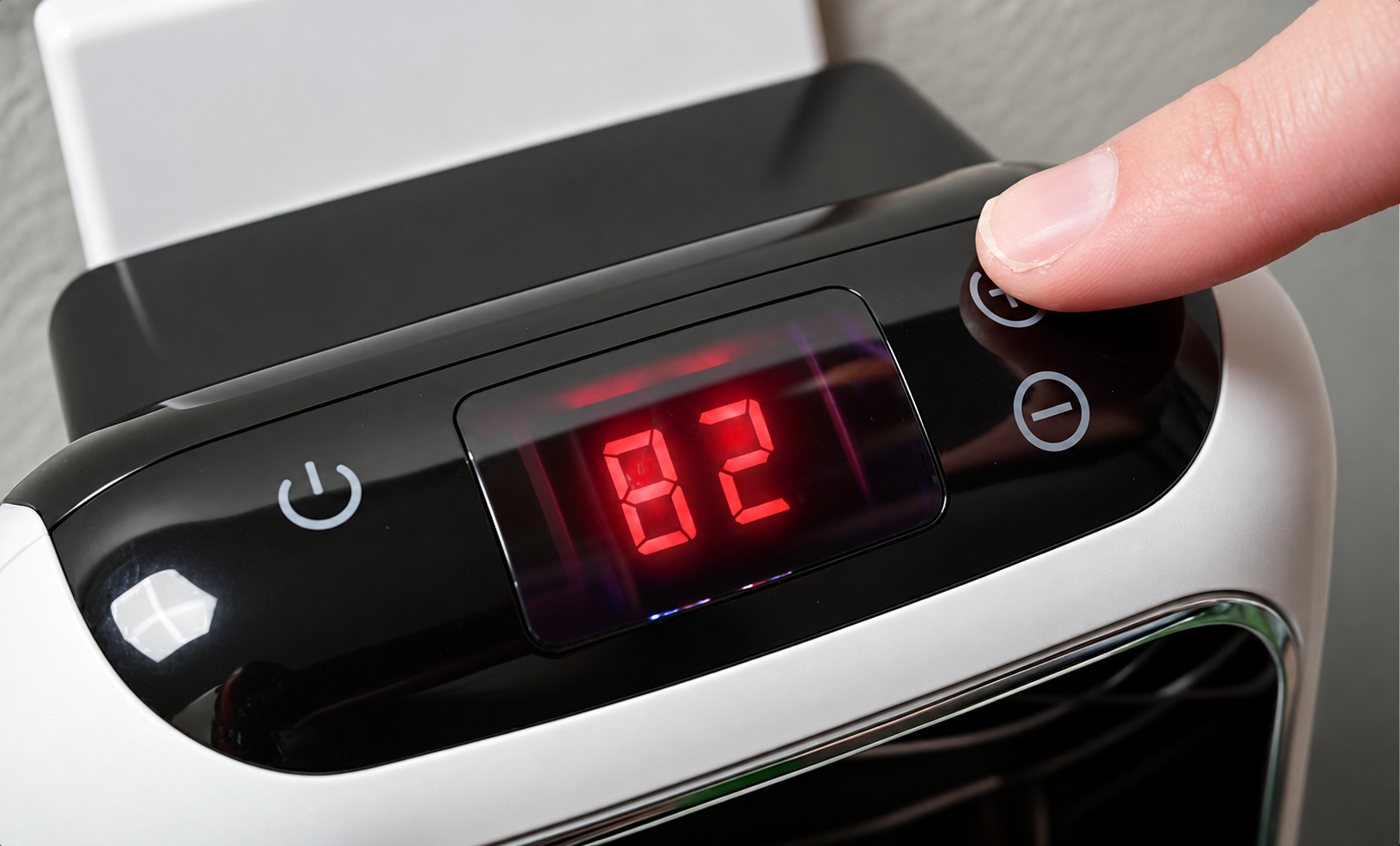
| Controls | Touch panel + wireless remote |
| Timer | Built-in auto shut-off timer |
| Safety | Tip-over cut-off, cool-touch housing, cool-down mode |
| Filter | Washable antimicrobial dust filter |
| Power | Standard household wall outlet |
| Warranty | 12 months + 30-day money-back guarantee |
Questions we have not answered here? Email support@getwellheater.net — or read our shipping, returns and warranty terms in full.
Verdict: 800W is a practical middle ground
For a single bedroom, home office, or similar room up to about 130 sq ft, an 800W heater balances fast warm-up against reasonable running cost and circuit headroom — noticeably cheaper per hour than a 1500W unit while still reaching a comfortable temperature in about a minute. Going bigger only helps if the room genuinely needs the extra output.
If you're unsure which wattage suits your space, measure the room and use the sizing table above before comparing specific heater types or models, then check running costs for what 800W actually costs per hour where you live.
Frequently asked questions
Keep reading
Official website offer
Get up to 75% off WellHeater today
Order from getwellheater.net — the only place to get the genuine unit with the antimicrobial filter, tip-over shut-off and a 30-day money-back guarantee.
- Free shipping
- 30-day refunds
- Secure checkout